
Edward’s Gate Light
Shared Reading Books · Science · Year 4Edward’s model garden has a tiny gate light. He wants it to shine when visitors arrive and turn off when they leave. At first, he pulls a wire loose each time. Mum suggests building a switch so the connections can stay in place while he controls the light.

They lay out one low-voltage cell in a holder, a matching bulb, insulated wires and a paperclip contact. Mum checks the parts. Their model uses a small battery supply only. It will never be connected to a wall socket, a charger or any household electrical cable.

Edward connects the parts into one loop with Mum’s help. A gap remains at the paperclip switch. The bulb stays dark. Electric current needs a complete conducting path through the bulb and back to the cell. A bulb sitting close to a battery is not enough.
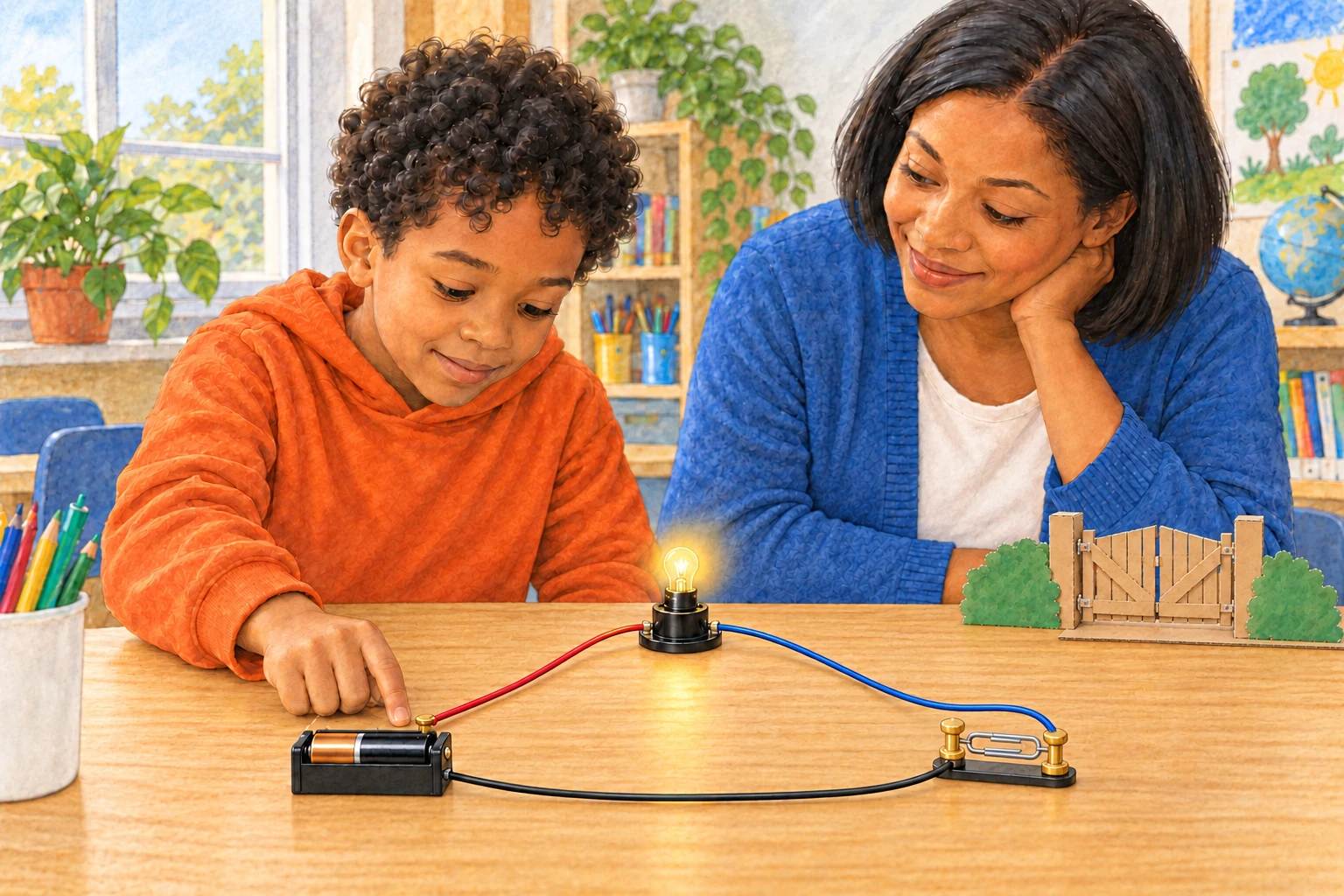
Edward turns the paperclip until it touches the other metal contact. Now the path is complete, and the bulb glows. “I did not add another battery,” he says. The closed switch joined the gap. Mum asks him to trace the loop with his finger above the wires.

He opens the switch again. A visible gap breaks the conducting path, and the bulb goes out. The switch has not used up the cell. Edward closes and opens it several times, checking that the light follows the switch position rather than simply guessing from one try.
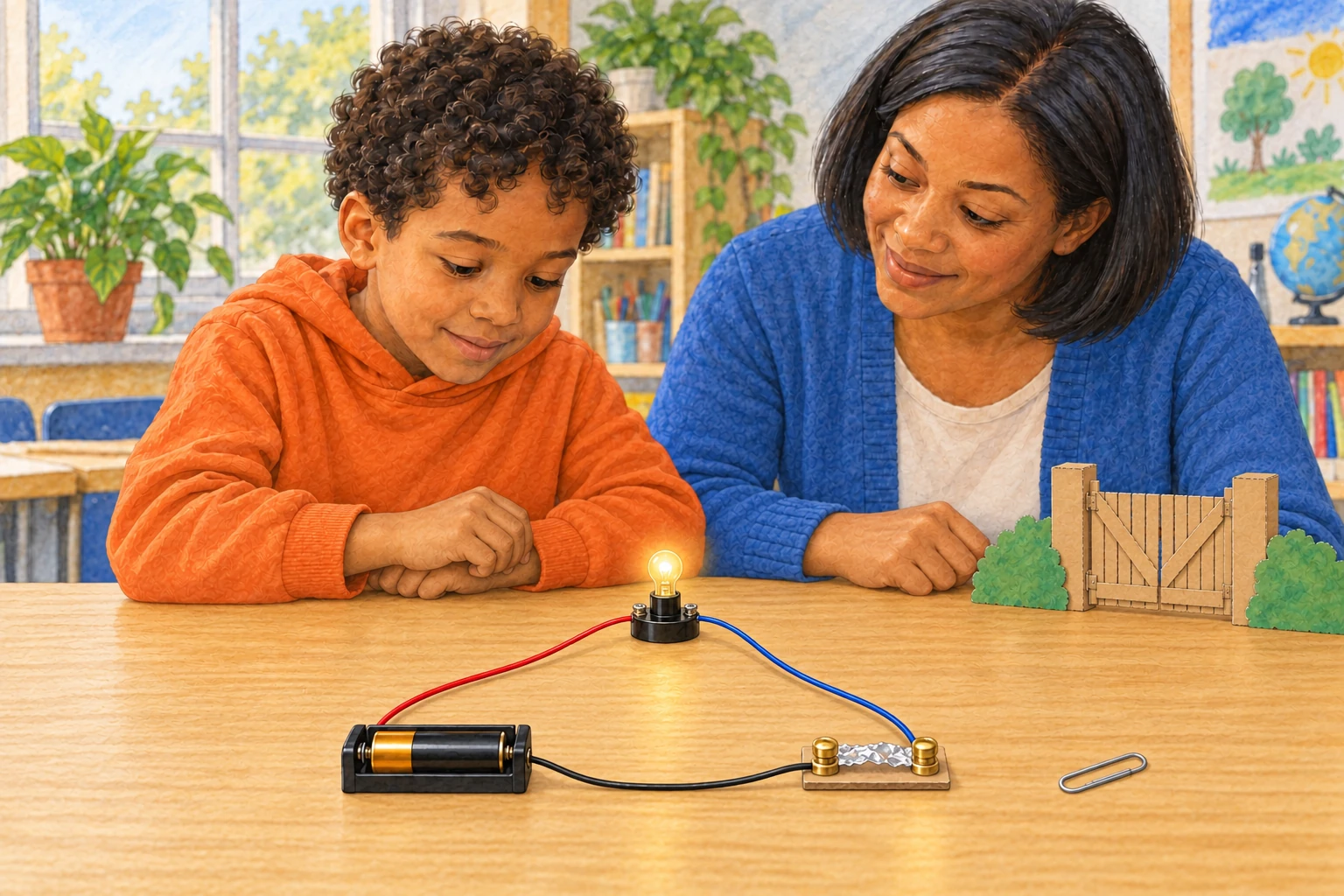
They briefly test a dry cardboard strip across the gap instead of the metal contact. The bulb does not light. A metal foil strip completes the path and lets it shine. Some materials are conductors; others are insulators. Mum prevents any direct connection between the cell’s terminals.

Edward fixes the switch beside his gate. His first attempt bends the paperclip too far, so the contacts do not meet reliably. He adjusts them with Mum instead of adding more cells. A loose connection can explain a dark bulb, but it is not the only possible cause.

When Mum moves a paper visitor through the gate, Edward closes his switch. The little lamp shines. When the visitor leaves, he opens it. “One complete path, then a gap,” he explains. His model now does what he wanted, and every wire stays neatly on the base.