
Thomas’s Magnet Hunt
Shared Reading Books · Science · Year 2Thomas is making a tiny card bridge when a paper clip slips underneath. His fingers will not fit into the gap. Mr Lane brings a large classroom magnet. “Could this help?” he asks. Thomas wants to know which objects the magnet will pull.

They gather a steel clip, a wooden peg, a plastic lid and a ball of aluminium foil. “I predict every shiny object will move,” says Thomas. Mr Lane suggests testing each one instead of deciding from its appearance. The objects wait on a clear table.

Thomas slowly brings the magnet near the steel clip. The clip slides towards it without his hand touching the clip. “Attract means pull towards,” Mr Lane explains. The magnet and this steel object interact even across a small gap.
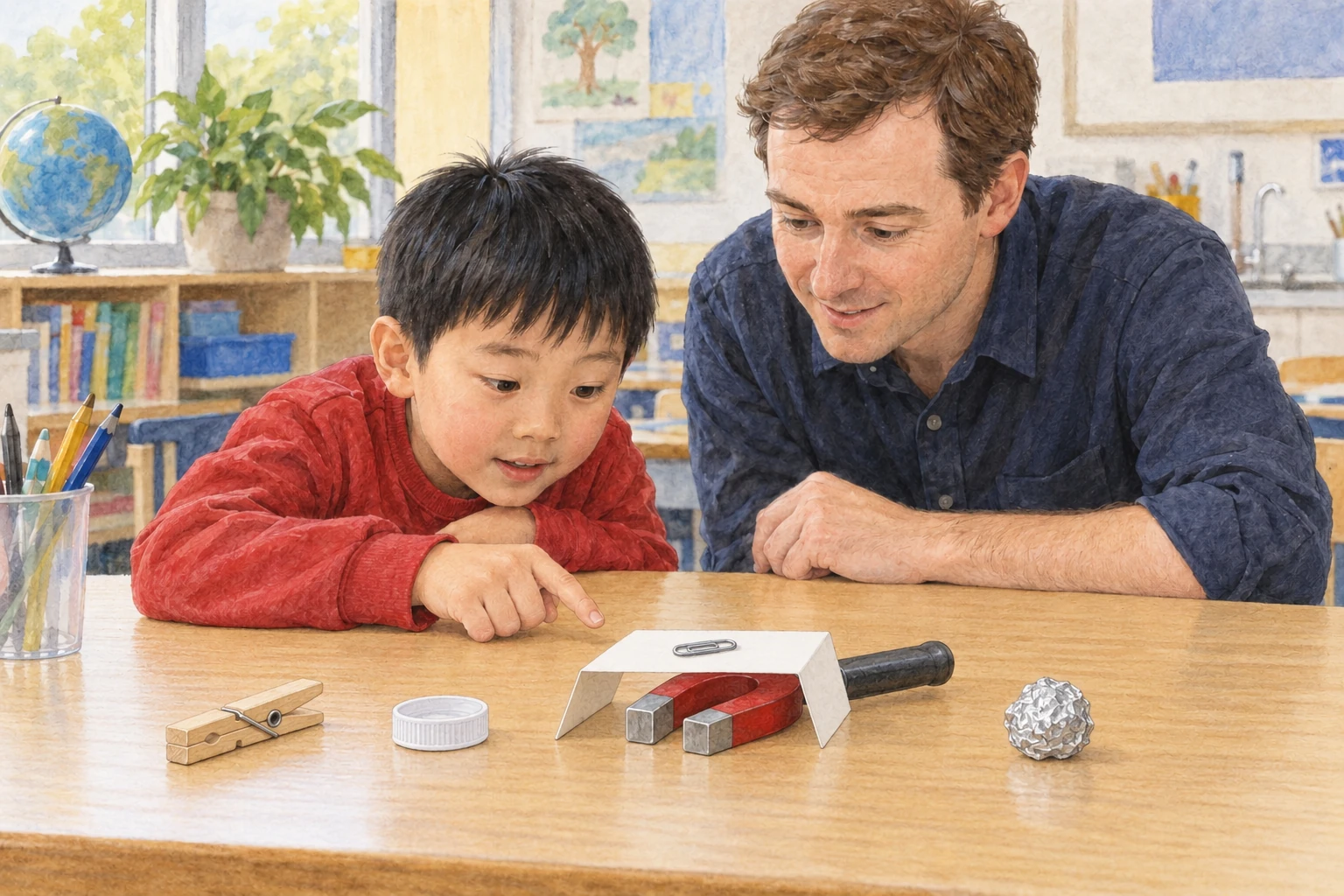
The wooden peg and plastic lid stay still. So does the aluminium foil ball. Thomas looks surprised. “That one is metal!” he says. Mr Lane explains that magnets attract some materials strongly, including this steel, but not every kind of metal.

They place the clip on thin card and move the magnet underneath. The clip follows. The card has not become magnetic. The attraction can act through this thin layer. Thomas repeats the movement slowly, keeping the magnet close to the clip.

A thick stack of books makes a much larger gap. This time the clip does not follow. “Distance matters in our test,” says Thomas. They have not proved that every magnet behaves exactly like theirs, or that every barrier always blocks a magnetic pull.

Thomas moves the magnet above the card bridge. The hidden clip follows towards the open side. At last he can reach it. He checks that the bridge is steady before finishing his model. The failed predictions were useful steps towards solving his problem.

He draws the objects that moved and those that stayed still. Next to the shiny foil, he draws a careful cross in his record. “Shiny was not a good enough clue,” he says. Now he would rather test a material than guess from its colour.